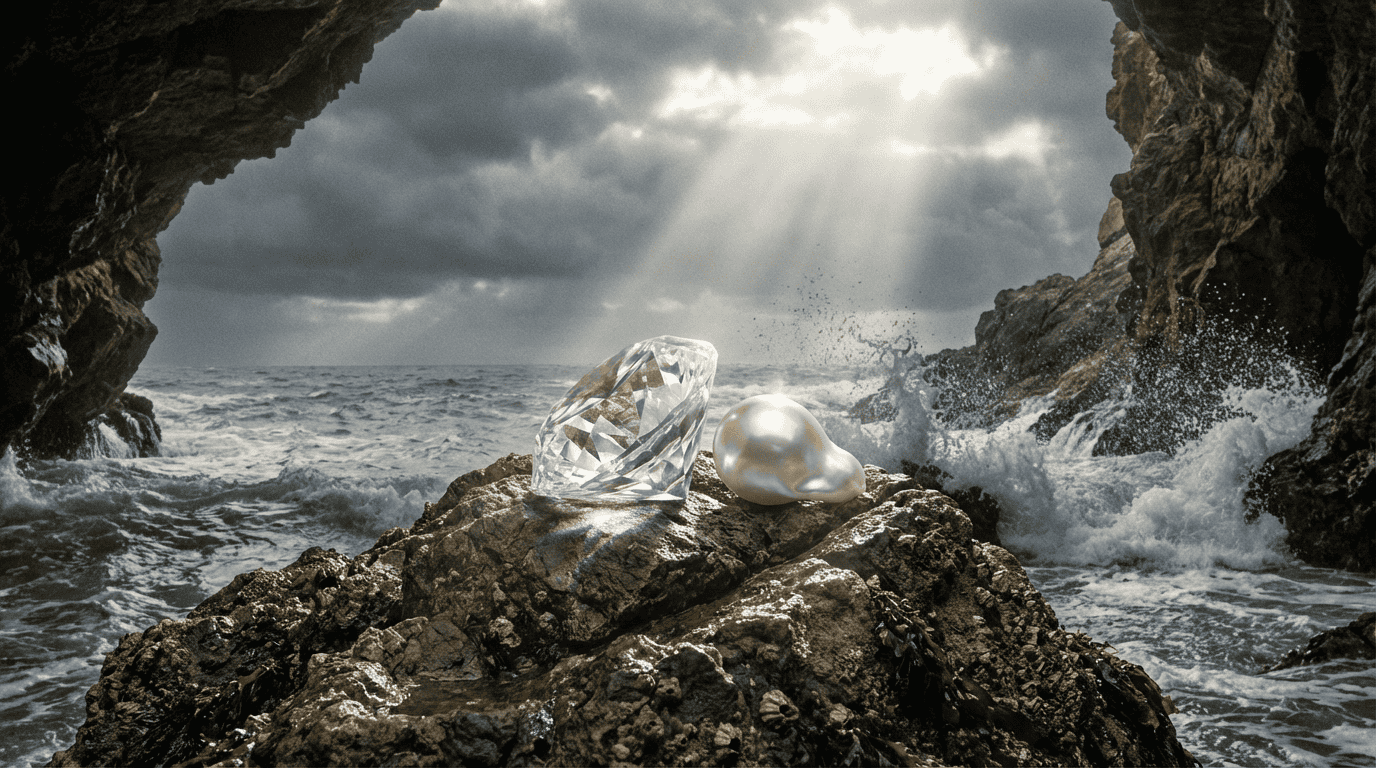
When I was younger, my friend Lee Asher used to ask a question that stuck with me.
Are you a diamond or are you a pearl?
At the time, he was creating material that would later become seeds for what the world now calls cardistry. He was exploring flourishes, eye-catching visual movement, bold textures in card handling. His magic had flash and confidence. It announced itself.
I was heading in almost the opposite direction. I didn’t want the audience to feel skill at all. I wanted smoothness. I wanted elegance. I wanted to remove any sense that something difficult was happening. If there was technique, I wanted it invisible.
Lee liked diamonds.
I was chasing pearls.
The point of the metaphor isn’t which one is better. The point is that eventually, you have to choose.
When we begin in magic, most of us just want to get good. We learn sleights. We collect tricks. We absorb methods. We chase improvement without asking what we are improving toward. That phase is necessary. You can’t skip fundamentals.
But once the mechanics begin to live in your hands, a different question appears.
What do you want your magic to look like?
Not what tricks do you want to do.
What do you want it to feel like in the room?
Do you want it to sparkle? Do you want it to glide? Do you want people to admire the architecture? Or forget there was architecture at all?
The diamond is cut and deliberate. It catches light. It announces its edges. There is pride in its precision.
The pearl forms slowly. It doesn’t flash. It has depth instead of glare. It rewards a different kind of attention.
Neither is superior. But they are not the same.
This isn’t just about card handling. It applies to everything. The way you speak. The pace of your routines. The plots you choose. The way you reveal an effect. The amount of apparent effort you allow to remain visible.
You are shaping a flavor whether you intend to or not.
A useful comparison is music. A great band develops a sound. You hear a Rolling Stones track and you know it within seconds. When someone asked recently whether their newest album was great, the answer from many fans was simple: it sounds like the Rolling Stones. For people who love that sound, that’s enough.
In art, consistency of flavor becomes identity.
In magic, this often happens by accident unless you take ownership of it. You might find yourself doing tricks that technically work but don’t quite feel like you. Or you might notice that audiences respond most strongly when you lean into a certain texture — a certain tone — even if you haven’t formally named it yet.
The diamond and the pearl are just a way of asking: what kind of surface are you polishing?
Early in your development, it doesn’t matter. Later, it matters more than almost anything.
Because once you know the flavor you’re developing, decisions get easier. You stop chasing every clever method. You stop trying to master every style. You refine toward a direction instead of in all directions.
And when that direction becomes consistent enough, people begin to recognize your work the way they recognize a band.
They may not analyze why it feels the way it does.
They just know it’s you.
At some point in your development, getting better is no longer the central task.
Deciding what you are becoming is.
That’s when the question stops being playful.
Are you a diamond or a pearl?
Come explore what kind of magician you’re becoming
Lee Asher, Danny Garcia, and BJ Bueno are joining Adam Grace and me at this year’s CC Summit. If this question resonates with you, this is exactly the kind of conversation we’ll be having — in the room, live, with artists who have shaped modern magic in very different directions.